

Believing Survivors Means Building Something Better
Support for Kendra Clark's Resolution: R26-004 - A Resolution Affirming Savannah DSA’s Commitment to Believing Survivors of Sexual Assault in Honor of Sexual Assault Awareness Month

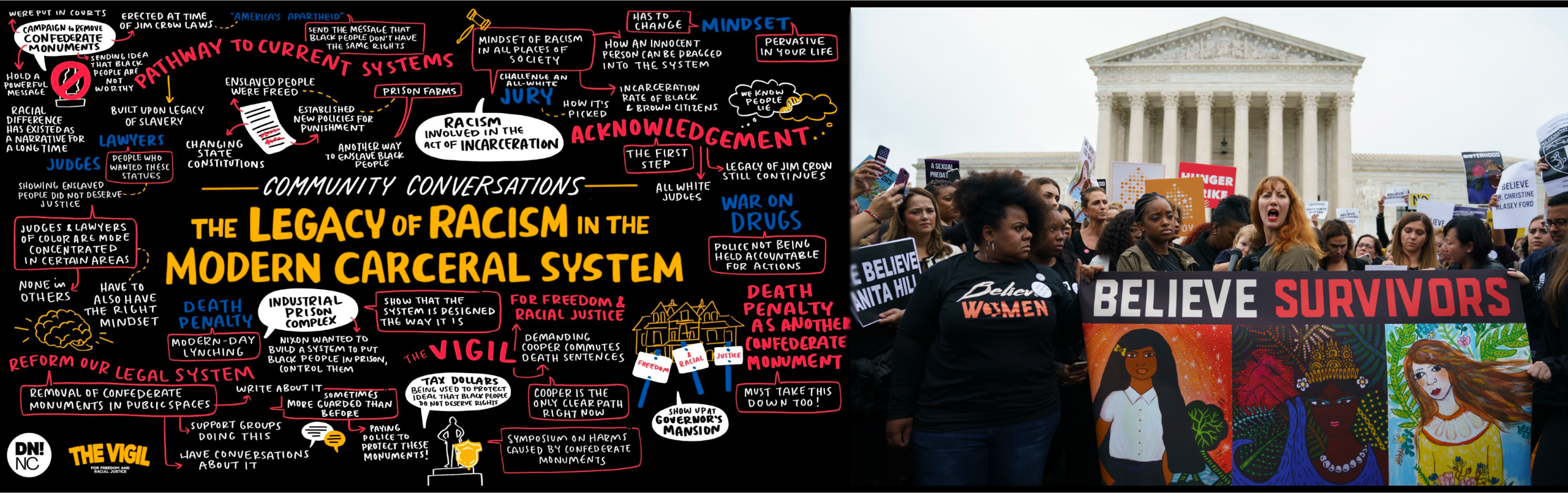
This month is Sexual Assault Awareness Month. Like every other “awareness” and “appreciation” month, it is a stark reminder that we have so much more work to do. The statistics are brutal, heartbreaking, and well-documented. An American is sexually assaulted roughly every 68 seconds. Over 440,000 people aged 12 and older experience sexual assault or abuse every year. 81% of women and 43% of men report experiencing sexual harassment or assault in their lifetimes. And as pointed out in Savannah DSA Resolution R26-004, Black, Indigenous, and LGBTQ+ people experience it at even higher rates.
And here’s the number that should haunt every person who claims to care about survivors: fewer than 30 out of every 1,000 sexual assaults result in a felony conviction. The system that is supposed to deliver justice for survivors fails them over 97% of the time. Survivors who do report face re-traumatization, victim-blaming, invasive forensic exams, and prosecutors who won’t take the case. The carceral system does not protect survivors. It never has. It was not designed to.
So when socialists say “believe survivors,” what are we actually committing to? Because if the answer is “defer to the criminal legal system,” then we are telling survivors and their allies to trust the same institutions that fail them 97% of the time. An institution that incarcerates Black people at six times the rate of white people.
Believing survivors means building alternatives away from the ones founded on white supremacy and the patriarchy. It means community accountability, material support -- housing, wages, childcare, mental health resources, healthcare -- that reduces the economic dependence that traps people in dangerous situations. It means creating processes inside our organizations that don’t replicate the failures of the system we claim to oppose.
That’s what restorative justice is. It is a survivor-centered framework. It does not dismiss harm. It does not sweep allegations under the rug. What it does is reject the idea that the only way to take harm seriously is to default to the logic of punishment and exclusion -- a logic that, in practice, falls hardest on Black and Brown people, on poor people, on queer people even among communities who claim to be their advocates. The same communities that experience the highest rates of sexual violence are the communities most brutalized by the carceral system’s version of “accountability.”
Believing survivors, a commitment to restorative justice, and a rejection of white supremacy are inseparable if we are to truly live according to our values as socialists. The only people who benefit from framing them as contradictions are the ones who want the white supremacist and patriarchal carceral default to remain unchallenged -- who need the proletariat to default to the path of least resistance out of their own exhaustion.
I’ve been thinking about this a lot in the context of our chapter. Savannah DSA adopted a Members Handbook that says, in writing, that the chapter prioritizes restorative and educational approaches to conflict resolution. The 2021 National DSA Convention passed Resolution 03 committing the organization to abolitionist politics and Resolution 28 creating a national committee to train chapter grievance officers in transformative and restorative justice. Both passed with supermajority support. It is the stated direction of our organization at every level.
But stating a value and building the infrastructure to live it are two different things. When a chapter lacks a framework for restorative justice, what happens in practice is predictable. Allegations arise. People panic. The path of least resistance wins. And the path of least resistance, in a society built on carceral logic, always looks the same: charge, sideline, forget. No process. No accountability committee. No examination of racial bias. No consideration of whether the response reflects the organization’s values or just reproduces the defaults we absorbed from the culture we grew up in.
A predominantly white chapter operating in the Deep South has to be honest about what those defaults are. When a Black organizer is accused by the state -- not convicted, accused -- and the chapter’s response is to push them out without a formal process, without any framework rooted in the justice principles we claim to hold... that is not believing survivors. That is the carceral system operating through us by proxy. The same system that convicts fewer than 25 out of every 1,000.
Building a restorative justice framework doesn’t weaken survivor protections. It strengthens them. A Community Accountability Committee that reflects the racial, gender, and political diversity of our community. A process that centers the dignity of all parties. A requirement that any restriction on a member’s participation goes to the full membership for a vote, not five or three predominantly white officers in a room. A policy that says the existence of criminal charges alone -- charges made by a state that we know, with extensive documentation, disproportionately targets marginalized people -- will not automatically determine someone’s standing in our organization.
That framework gives survivors more than the carceral system ever has. It gives them a process that actually listens. It gives them a community that takes harm seriously enough to build something better than a system with a 97% failure rate. And it gives every member of the chapter the assurance that if they are ever accused of anything, by anyone, their standing will be determined by a fair, democratic, transparent process. Not driven by panic, not by social pressure, and certainly not by the biases that none of us are immune to.
Dolores Huerta carried her secret for decades because she believed the movement was more important than her pain. That is a devastating indictment -- not of Huerta, but of every organization that creates conditions where a survivor feels they have to make that choice between the movement and justice, organizations that refuse to acknowledge the patriarchy, white supremacy, and rape culture of the system it was built within. Restorative justice is how we make sure no one in our chapter ever faces that calculus. It builds the infrastructure so that harm can be addressed without destroying the person who reports it or the person who is accused. It refuses the false binary that says you must choose between believing survivors and providing due process in accordance with our values.
We can do both. We must do both. Anything less is not a socialist organization. It's a liberal space cosplaying as activist, talking about justice but defaulting to the same broken systems when things get uncomfortable. We become no better than the liberal and conservative organizations that fight every day to defend the status quo or drag us further backwards.
I’m asking the membership of Savannah DSA to vote YES on Savannah DSA Resolution R26-003 & Savannah DSA Resolution R26-004. Vote yes on establishing our commitment to both Restorative Justice and Survivors. These are the same vote.
In solidarity,
George Robles
Co-Chair, Steering Committee
Savannah DSA